The engineering nobody is meant to see
Every arrangement rests on a decision about what will hold it up — and that decision shapes everything that follows.

Floral foam, the dense green block sold under the trade name Oasis, is still the most common armature for large pedestal work. It is pre-soaked in water until it sinks of its own weight, then fitted tightly inside a container so no stem can shift once placed. The physics are simple: foam grips a cut stem and holds water against its end simultaneously. The design drawback is equally simple — a stem pulled out tears the foam, leaving a cavity that won't grip again, which means placements are final. Florists working in foam think in sequences: the longest structural stems go in first to set the geometry, filler comes next, and detail flowers last. There is no revising the order.
Wire and tape exist to extend or replace what a stem cannot do on its own. A dahlia with a hollow stem is threaded with a gauge-appropriate wire pushed through the calyx and bent back on itself; gutta-percha tape — a brown or green wax-backed adhesive bandage used in the trade — is then wound tightly down the whole length to bind wire to stem and seal the join. The result looks, from any reasonable distance, like an ordinary stem. Boutonnières, corsages and anything pinned to a lapel or wrist are almost entirely constructed this way, since their true stems would be an inch long and useless.
Frogs — the spiked metal or plastic discs weighted to sit on the bottom of a vessel — give an alternative to foam for open-topped arrangements in clear or ceramic containers. A stem is pressed onto the pins, held by friction alone. Because nothing pierces or surrounds the stem, placements can be adjusted, which makes frogs the preferred mechanics for designers who build arrangements iteratively rather than sequentially.
Chicken wire crumpled into a loose ball inside a container performs a similar function at larger scale. It offers dozens of irregular apertures for stems, holds nothing rigid, and allows a loose naturalistic silhouette that foam — with its tendency to push stems upright — makes harder to achieve.
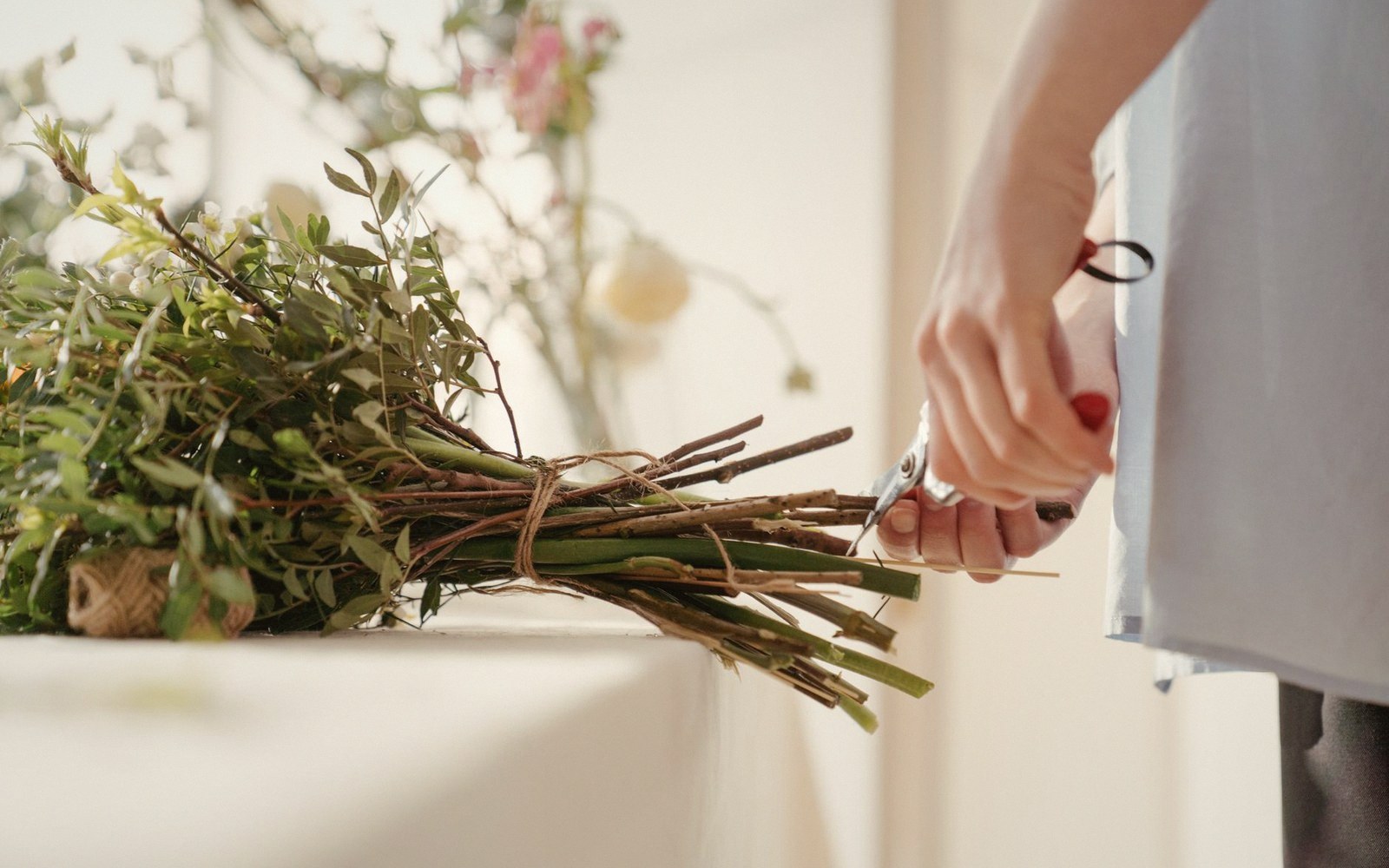
None of this is decorative. All of it disappears under the finished arrangement, below a waterline or behind foliage. The mechanics exist only to solve the engineering problem — keeping a thing alive and upright for the few hours it is needed to be both.